
Built for everyday operations
Control 7 energy management display
Control 7 makes energy flow, diagnostics and local decision-making visible on-site.
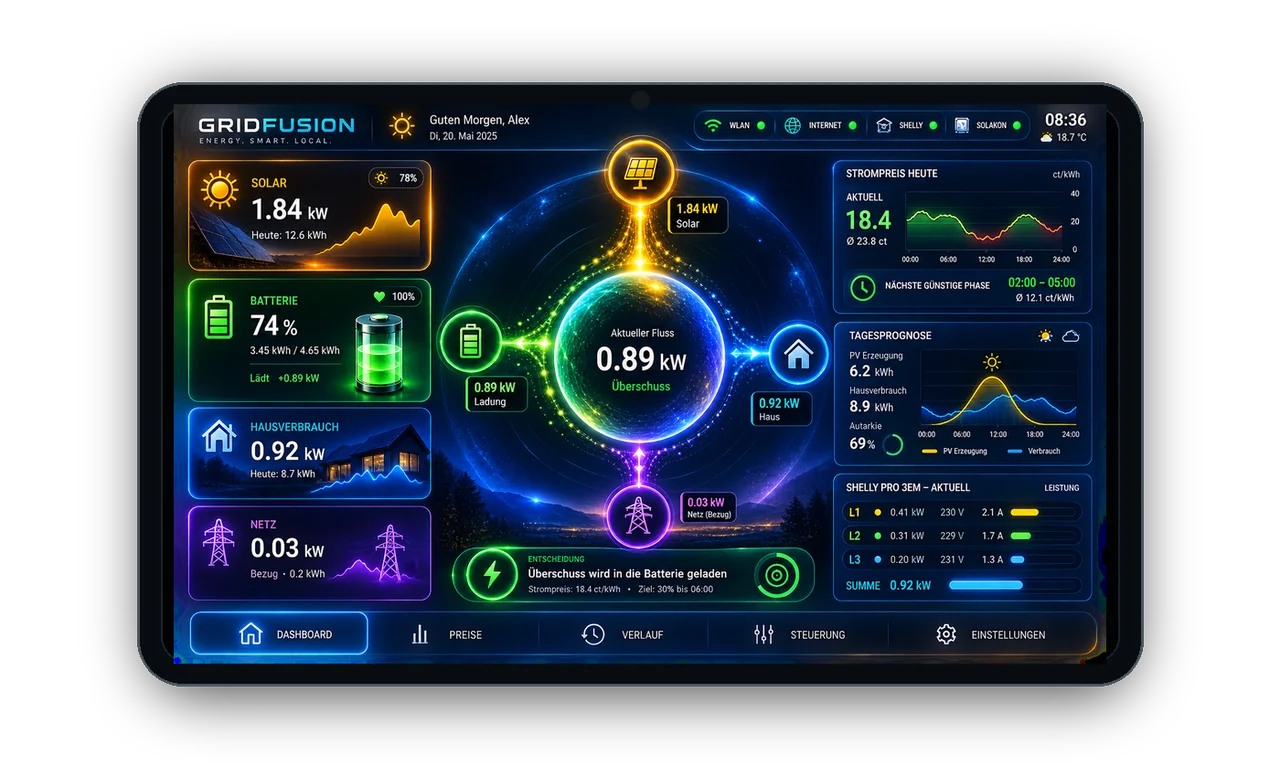
Control 7 is the local centre of GridFusion
Control 7 combines display, configuration, diagnostics and local energy management in one device. Its 7-inch touchscreen presents more than individual readings: it shows how photovoltaics, battery storage, household consumption and the grid relate to each other. The current state remains visible at the installation itself without first opening a smartphone app or cloud portal.
The hardware is based on the Waveshare ESP32-S3-Touch-LCD-7C-BOX. The defined target has an 800 × 480 pixel landscape display, ESP32-S3, 32 MB flash and 16 MB PSRAM. GridFusion uses ESP-IDF 5.5.3, C++17 and LVGL. These specifications describe the current development platform, not a final and unchangeable series-production data sheet.
Energy flow and system health at a glance
The home view arranges solar, battery, home and grid as one spatial energy flow. Live readings use native overlays on top of a fixed, tested design. Additional views provide history, electricity prices, solar forecasts, device diagnostics, network information and settings. Bundled Inter fonts provide consistent presentation without downloading font files from the internet at runtime.
Every displayed value has a state. “Healthy”, “impaired”, stale or “–” are not interchangeable designs but different technical statements. If a driver does not provide fresh and plausible data, Control 7 does not simply present an old value as current. That transparency matters because missing grid metering also affects safe battery decisions.
Local operation without mandatory cloud control
Essential measurement, state building and control run locally. Control 7 therefore remains the authority for sensitive device settings and operator consent. The central portal may display status and approved diagnostics, but it can neither address a device driver directly nor bypass the Solakon Safety Gate.
Tasks needed for control are separated from network and storage operations. The LVGL interface does not wait for slow I/O. External electricity prices, weather data, forecasts, backup and OTA updates add to local operation but are not prerequisites for fundamental local acquisition. If internet access is missing, the condition becomes visible instead of changing local control in an uncontrolled way.
History with and without an SD card
Control 7 is designed so that a missing SD card does not stop the energy path. Measurement, diagnostic, price and forecast records pass through bounded queues to one Storage Manager. With a healthy SD card, SQLite is the primary history store. Without it, a bounded, CRC-protected, append-only LittleFS segment provides the fallback.
Configuration is never deleted to make space for history, and an SD card is not formatted automatically. When retained records are later migrated to SD, the operation must be resumable, idempotent and verified before the local copy may be removed.
Safe device control is a separate capability
Observation and writing are separate capabilities. A device may provide measurements without granting GridFusion permission to control it. For Solakon ONE, the controlled write adapter sits behind a central gate. Without explicit activation of solakon_write_enabled, no vendor-specific write is executed. Normal firmware must not enable the write path automatically.
Current development includes a tightly bounded commissioning path and technical read-back checks. General hardware approval additionally requires supervised real-world tests, long-running observation and documented outage scenarios. This website therefore describes Control 7 as a development and pilot device.
The same interface in a safe simulator
A Windows simulator renders the same LVGL views at 800 × 480 pixels for testing and media production. It produces reproducible scenes, screenshots and videos without sending a hardware command. The product demo on the home page comes from this rendering path; it is not a freely recreated web animation.
The simulator does not replace validation on the ESP32-S3 device. Memory limits, touch behaviour, network, display and time-critical processing are also checked in the firmware build and on real hardware. How GridFusion works explains the wider technical context; the current scope is listed under features.